We Could Have Been Colonizing the Moons We Could Have Been Colonizing the Moons Baby Boomers
 Sixty years after the founding of the National Aeronautics and Space Assistants (NASA), most Americans believe the United States should exist at the forefront of global leadership in space exploration. Majorities say the International Space Station has been a good investment for the land and that, on residue, NASA is still vital to the future of U.S. space exploration even as private space companies emerge as increasingly important players.
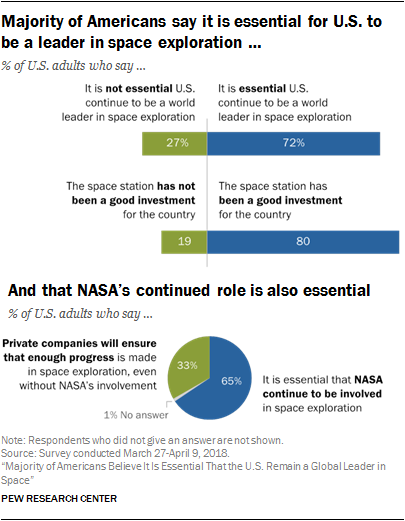
Roughly seven-in-ten Americans (72%) say it is essential for the U.Due south. to continue to be a world leader in space exploration, and eight-in-ten (fourscore%) say the space station has been a skillful investment for the country, according to a new Pew Research Heart survey conducted March 27-April 9, 2018.
These survey results come at a fourth dimension when NASA finds itself in a much dissimilar earth from the one that existed when the Apollo astronauts offset set foot on the moon well-nigh half a century ago. The Common cold State of war space race has receded into history, but other countries (including China, Nippon and India) have emerged as significant international players in space exploration.
And, equally the individual sector increasingly ventures into space – through companies such as SpaceX, Blue Origin and Virgin Galactic – 65% of Americans believe NASA should notwithstanding play a vital function in the exploration of space, while a third (33%) say private companies will ensure enough progress in this area even without NASA's involvement.
Strong public support that the U.S. should continue to exist at the vanguard of space exploration is widely shared across gender, educational and political groups. Each generational group, for example, expresses nearly equal levels of strong support for continued U.S. space leadership – from Babe Boomer and older generations (71%) who lived through the "Right Stuff" era that pioneered space exploration to Millennials (70%) who grew upward during the space shuttle program. Indeed, on nearly bug regarding NASA and infinite exploration, at that place are no more than modest differences among the generational cohorts. Run across the Appendix for details.
Similarly, majorities beyond gender, generation, education and political groups see benefits from government investment in one of NASA'southward signature projects, the International Space Station (ISS). The findings – support for the U.S. existence at the forefront of infinite exploration and the perception that the space station has been a good investment – are broadly consistent with previous Pew Enquiry Centre surveys, which used somewhat different wording and polling methods.
While the ISS has proven to be an enduring legacy of the U.S. infinite plan, information technology is also emblematic of changing times. NASA currently relies in part on the Dragon spacecraft, built and operated by Elon Musk'southward SpaceX company, to evangelize supplies to the orbiting laboratory. And the Trump assistants has been exploring the possibility of turning the space station into a commercially run venture subsequently 2024.
As Americans consider the future of the U.South. space programme, most (65%) still come across an essential function for NASA, while a third (33%) believe "private companies will ensure that plenty progress is made in space exploration, even without NASA's involvement." Democrats and independents who lean Autonomous are more probable than Republicans and independents who lean Republican to believe that NASA should continue to play a role in space exploration (70% vs. 59%). Conservative Republicans are closely divided on this outcome (53% to 47%), though two-thirds (67%) of moderate or liberal Republicans believe a connected role for NASA in U.South. space exploration is essential.
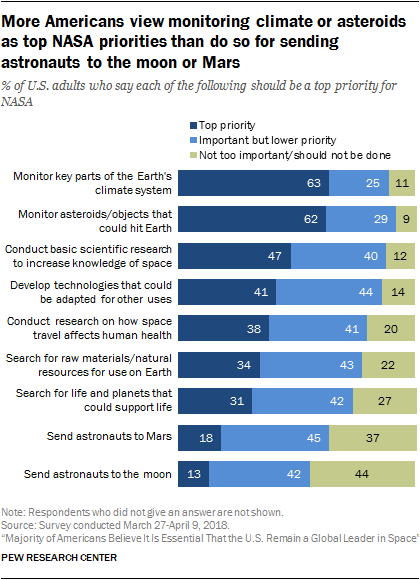
Majorities say monitoring climate or tracking asteroids should exist a meridian NASA priority; only 13% say the same of putting astronauts on the moon
 NASA oversees a various portfolio of space-related missions, from sending robotic probes to explore afar planets to launching satellites that study Earth's atmosphere and oceans.
When asked to rate the importance of nine of these missions, majorities of Americans say a elevation priority for NASA should be monitoring cardinal parts of the Globe's climate organization (63%) or monitoring asteroids and other objects that could potentially collide with the Earth (62%).
Slightly fewer than half of Americans (47%) believe that conducting basic scientific research to increment knowledge and understanding of space should be a pinnacle priority, with twoscore% saying such research is an important but lower priority. Some 41% say developing technologies that could be adjusted for uses other than space exploration should exist a top priority, and 44% characterize it every bit an of import but lower priority for NASA. And 38% believe NASA should brand information technology a summit priority to carry scientific research on how infinite travel affects human health, while 41% encounter it as an of import but lower priority.
Around one-third of U.S. adults say that searching for raw materials and natural resource that could be used on Globe (34%) or searching for life and planets that could back up life (31%) should be superlative priorities; 22% and 27% of Americans say, respectively, that these missions are non too important or shouldn't be pursued.
Missions for human astronauts to explore Mars and return to the moon are amongst NASA's most high-profile programs. The Trump administration has expressed strong support for these initiatives, saying that exploring the solar system should be NASA'southward core mission, start with a render of astronauts to the moon.
 Notwithstanding, compared with other NASA programs, fewer Americans say such space exploration should be a top priority. Only 18% and xiii%, respectively, say that sending astronauts to Mars or back to the moon should be a height priority; 37% and 44%, respectively, limited the view that these missions are not as well important or that NASA shouldn't undertake these missions.
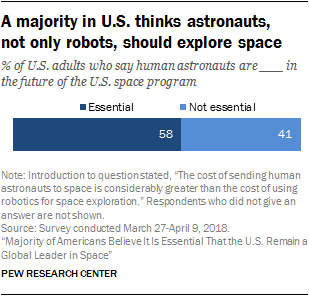
Some space experts argue that the life support systems required to sustain astronauts on a long interplanetary journey would be and so expensive that information technology would be more cost-effective to send robotic probes.1 With regards to future expeditions into infinite, a bulk of Americans say they would consider it essential that humans, non solely robots, brand the trip. Overall, 58% of U.S. adults believe it is essential to include the utilize of human astronauts in the U.Southward. infinite program, while 41% say astronauts are non essential.
Republicans and Democrats tend to hold about the relative priorities of NASA'south efforts. For example, nigh six-in-ten of each party say that monitoring asteroids should be a top priority for NASA (61% of Republicans and 63% of Democrats, including those who lean to each party). But Republicans tend to put monitoring the Earth's climate arrangement equally a lower priority for the agency, consistent with long-standing political divides over climate issues. Fewer Republicans and Republican-leaning independents (44%) than Democrats and Democratic leaners (78%) believe that monitoring the Earth's climate arrangement should be a top priority for NASA. Some 38% of Republicans say that monitoring the Globe's climate organisation should be an important but lower priority, and 17% say this is not too important or should not exist done.
Republicans are also less probable than Democrats to see bones scientific research to farther knowledge of space as a summit priority. Some 38% of Republicans and those who lean to the GOP consider this a acme priority for NASA, while 46% phone call it an of import but lower priority. Nigh half (53%) of Democrats and leaners consider bones scientific enquiry a acme priority for the agency.
The new survey finds men more than likely than women to consider several of these missions a top priority for NASA, including conducting basic scientific research (54% of men vs. 40% of women say this should be a height priority). While a minority considers putting astronauts in infinite a top priority for NASA, more men (25%) than women (11%) consider man exploration of Mars a top priority.
In add-on, while most half or more than of men and women believe human astronauts are essential for the U.Southward. infinite program, more men (63%) than women (54%) hold this view. This finding is in keeping with a 2014 Pew Enquiry Center survey, which used somewhat unlike question diction and polling methods. (Also meet Appendix for views on these issues past gender.)
Men as well tend to express more interest in space and astronomy news, according to a 2017 Pew Research Eye survey as well equally surveys conducted for this year'southward Science and Technology Indicators report.
There are no more than modest differences by education level in agency priorities. One exception is that those with at least a postgraduate caste are more likely than those with high school or less education to consider basic scientific inquiry a tiptop priority for NASA (63% vs. 38%). Run across Appendix for details.
Most Americans express confidence that individual infinite companies will be profitable, but are skeptical that those companies will minimize chancy space debris
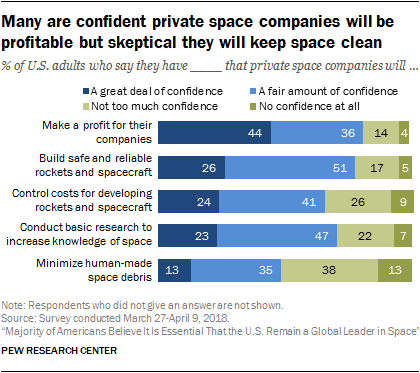 Private companies such as SpaceX, Blue Origin and Virgin Galactic continue to develop infinite exploration capabilities that were once the sole purview of government agencies such every bit NASA. Some 44% of Americans have a great deal of confidence these companies will make a turn a profit in their space-related ventures, with 36% saying they are fairly confident that space companies will be profitable.
Although nearly Americans believe that NASA still has an essential role to play in the exploration of space, they also express conviction that private companies tin can make meaningful contributions in such areas as developing safety spacecraft and conducting research to expand scientific noesis.
For instance, almost one-in-four Americans say they have a great deal of conviction that individual companies will build safe and reliable rockets and spacecraft (26%), and around half of Americans (51%) accept at least a fair amount of confidence that space companies will exist able to exercise then.
Americans are by and large confident most the ability of private companies to command the costs of developing rockets and spacecraft – 24% accept a great deal of confidence and 41% have a fair amount of confidence, compared with 34% who have "not likewise much" confidence or no conviction at all. Moreover, 23% have a smashing deal of confidence and 47% have a fair amount of conviction that companies will conduct basic research to increment knowledge of space, compared with 29% who don't have much confidence or have no confidence at all.
Americans, notwithstanding, tend to be skeptical about whether private companies will minimize human-made space debris, which increasingly poses a hazard to orbiting satellites and space stations. Only 13% of U.Southward. adults take a not bad bargain of confidence that companies will minimize that trouble, with 35% maxim they have a fair amount of confidence. By comparison, about half of Americans (51%) have not as well much or no confidence that private companies volition minimize homo-fabricated space debris.
Men limited more confidence than women in private space companies' abilities in nigh of these areas, especially when it comes to building price-constructive and safe spacecraft. For case, 74% of men but 56% of women have at least a fair corporeality of confidence these companies will control costs, and 85% of men vs. 69% of women accept at least a off-white corporeality of confidence that private companies will build safe and reliable spacecraft.
Americans nigh attentive to space news especially value U.S. global leadership but are closely divided over importance of NASA in future space exploration
 A small share of the public, just 7%, is particularly attentive to space news, saying they take heard "a lot" most NASA in the past yr and "a lot" virtually private space companies. About a 5th of Americans (22%) take heard "nothing at all" about both of these while most Americans (71%) autumn in between these two extremes, having heard at least a trivial either almost NASA or about individual companies developing space exploration capabilities.2
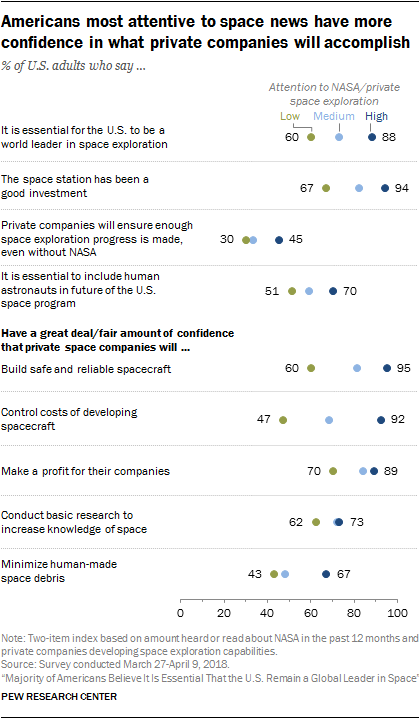
Those most attentive to space news stand out from other Americans for their stiff support for the U.S. being a world leader in space exploration and their belief that the International Space Station has been a practiced investment for the country. For instance, 88% of those who have heard a lot of space news believe information technology is essential for the U.S. to be a global leader in space exploration, compared with 60% of those who have heard cipher about NASA and private infinite companies. And 94% of the nearly space-attentive Americans consider the space station to have been a expert investment for the country, compared with 67% of those who have heard nothing about space news.
When thinking about priorities for NASA, Americans who are highly attentive to space news put more priority than other Americans on research missions such as bones scientific research and learning about the health effects of space travel. For example, three-quarters (75%) of those highly circumspect to space news believe bones scientific inquiry should exist a tiptop priority for NASA versus 31% of those with low attending to such news. Indeed, the share of this space-attentive group that considers basic research a top priority is like to the shares who say the same nigh monitoring objects in space that could collide with Earth (69%) and monitoring the climate system (68%).
But, while those who pay a lot of attending to space news tend to put more priority than other Americans on NASA's enquiry missions, they are more than closely divided than other Americans over the importance of NASA'south role in space exploration going forward. Among the virtually attentive, 55% say information technology is essential that NASA proceed to be involved in U.S. space exploration, while 45% say individual companies volition ensure enough progress even without NASA's involvement. Among other Americans, the remainder of stance leans more conspicuously toward NASA remaining involved. For case, 66% of those who pay a medium level of attending to space news say it is essential for NASA to remain involved, as do 68% of those with low attention to space news.
Those who have heard a lot about infinite news also tend to express more confidence in private infinite companies to handle key aspects of infinite exploration, especially building safe and toll-effective spacecraft. For instance, 95% of Americans who are almost attentive to news about NASA and private infinite companies take at least a fair amount of confidence that those companies volition build condom and reliable rockets and spacecraft; 58% of this group has a great deal of confidence in companies to do this. By comparison, lx% of those who have heard nix nigh NASA and private space companies have at least a off-white amount of confidence in individual companies to build safe and reliable spacecraft.
Space tourism? A majority of Americans say it's not for them, just 63% of Millennials are interested
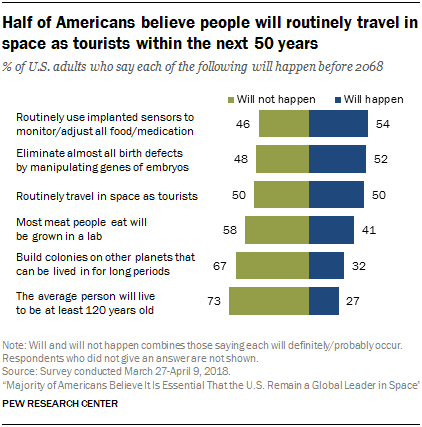 Americans wait a range of scientific and technological developments ahead. But the public is divided over the prospects for space tourism in the next 50 years. Half (50%) believe this will happen while half are skeptical this will be routine for ordinary people. About a third of Americans (32%) believe that colonies on other planets – habitable for long periods of time – will be built past the yr 2068, while two-thirds (67%) doubt this volition happen.
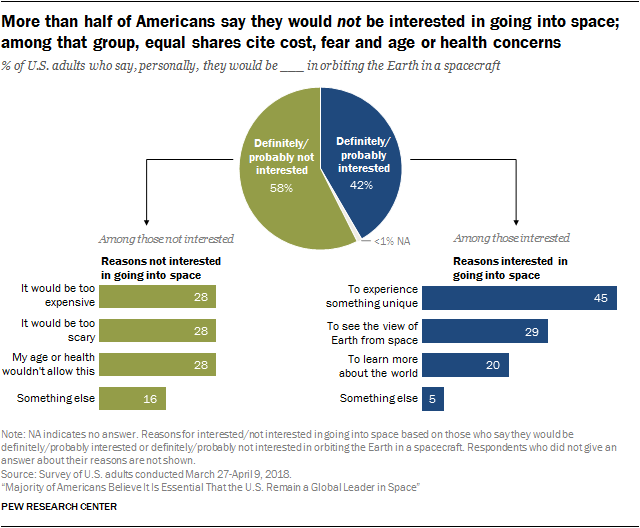
As the public considers the possibilities ahead for ordinary citizens to orbit the World in a spacecraft, more Americans say they would not desire to orbit the Earth than say they would (58% to 42%).
Interest in orbiting the Globe is greater among younger generations, men and those who are more than attentive to infinite news. Some 63% of Millennials (born 1981 to 1996) say they are definitely or probably interested in space tourism, compared with 39% of Gen Xers (born 1965 to 1980) and 27% of those in the Baby Boomer or older generations. Beyond all generations, men are more than likely than women (51% vs. 33%) to say they are interested in traveling into space as tourists.
Those who have heard or read a lot about NASA and private space companies are much more likely (74%) to say they are interested in space tourism than those who take heard nothing about such infinite news (xxx%).
Among the 42% of Americans who would be interested in traveling into space, 45% of them say the principal reason for their interest would be to "experience something unique." Some 29% of this grouping say they would go so that they can see the view of Earth from space, while xx% desire to "learn more about the world."
The 58% of U.S. adults who say they wouldn't want to orbit the Earth aboard a spacecraft believe that such a trip would be either "too expensive" (28% of those asked) or "too scary" (28%), or that their age or health wouldn't allow it (28%). Some xvi% of those non interested in space travel offered reasons other than the 3 options in the survey.
Source: https://www.pewresearch.org/science/2018/06/06/majority-of-americans-believe-it-is-essential-that-the-u-s-remain-a-global-leader-in-space/

Post a Comment for "We Could Have Been Colonizing the Moons We Could Have Been Colonizing the Moons Baby Boomers"